


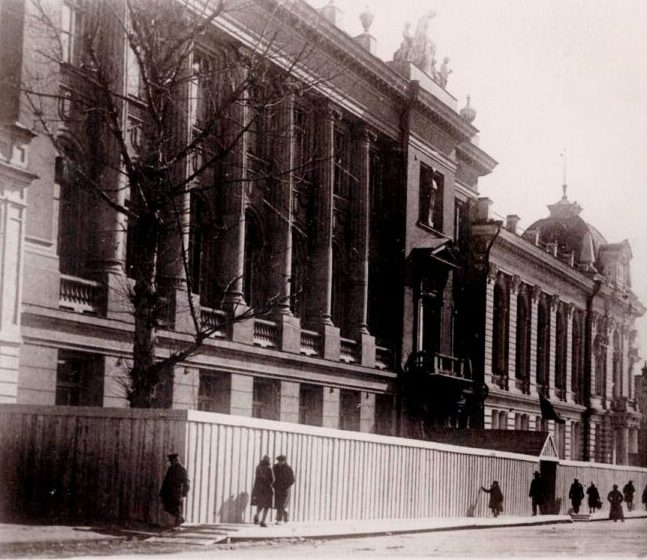
Nikolsky, H. (2010). The history of the transformations of a house on Sumskaya Street. LiveJournal. https://ngeorgij.livejournal.com/34897.html
Kharkiv Courier. (2022, April 21). Destroyed beauty. The history of the House of Soviets in Kharkiv. https://www.slk.kh.ua/news/khronograf/znisena-krasa-istoria-budinku-rad-u-harkovi.html
Ponomarenko, I. (2022, August 10). ХОДА. https://moniacs.kh.ua/harkivska-oblasna-rada/
The History of the Provincial Zemstvo Building
In the urban fabric, there are objects that appear so natural that their absence is almost unimaginable. Such is the building located at the corner of Sumskaya Street and Freedom Square in Kharkiv. Its history is not the story of a single structure, but rather a sequence of transformations reflecting shifts in political regimes, aesthetic paradigms, and the functions of urban space.
The development of this section of Sumskaya Street took place in the second half of the nineteenth century, when the city gradually expanded northwards. The area was settled by members of the intelligentsia and the liberal professions, and the planning structure of the district was formed and approved by the end of the century.
At the end of the nineteenth century, the building of the Provincial Zemstvo emerged here—an institution that performed functions of local self-government and social welfare. Zemstvos played a key role in the development of education, healthcare, and infrastructure.
Architecturally, the building, designed by Adolf Minkus (1898–1900), belonged to the Neo-Renaissance tradition: symmetry, decorative plasticity, and allegorical sculptures. It embodied the idea of institutional stability and public service. Later, the complex was expanded with a second корпус, forming an architectural ensemble. (author does not use this term explicitly, but the context implies the formation of a unified complex)
In the 1920s, the building was occupied by the Central Committee of the Communist Party and underwent a radical transformation under the direction of Yakov Shteinberg. Importantly, parts of the original façades were preserved, but the structure and architectural language were significantly altered—additional storeys were added, a new geometric articulation of the façade was introduced, and horizontal bands of windows created a sense of dynamism. The building ceased to function as a space of social service and became an instrument of administrative power. Even its internal organisation—placing leadership offices on the upper floors and controlling access—reflected a new hierarchy.
During the Second World War, the building was destroyed. The ruins were not restored; instead, they were dismantled, and a new structure was erected on the same site in the 1950s. The new design (by Orekhov, Kostenko, and others) differed fundamentally: symmetry, an order-based composition, and rich decoration became defining features of Stalinist post-war classicism.
Throughout the second half of the twentieth century, and especially after Ukraine gained independence, the building gradually lost its original ideological determinacy and acquired new functional and symbolic meanings. It began to be perceived not only as an administrative объект but as a stable element of the urban environment—a part of everyday spatial practice and the collective memory of the city. In this sense, a process of re-appropriation took place: from an instrument of political representation to an infrastructure of local self-governance.
The building functioned as an administrative centre and became an integral part of the Freedom Square ensemble. It stabilised as an urban landmark, while simultaneously retaining traces of its multilayered history—from the zemstvo institution to the партийный аппарат and the post-Soviet institutional framework. (author does not use this exact phrasing, but the context suggests a continuity of institutional transformations)
However, this stabilisation proved to be not final.
On 24 February 2022, the full-scale invasion of Ukraine by Russia brought into focus not only the physical destruction of the urban environment but also the dismantling of symbolic structures that sustain collective memory. In this context, Kharkiv became one of the cities where architecture itself turned into a direct target.
On 1 March 2022, the building on Sumskaya Street, known as the House of Soviets, was struck by missiles. Two Kalibr missiles hit the area of Freedom Square, causing severe damage. In the six-storey structure, floor slabs between several levels collapsed, while the blast wave damaged surrounding buildings. According to available data, as of 3 April 2022, 29 people were killed, including one child.

