


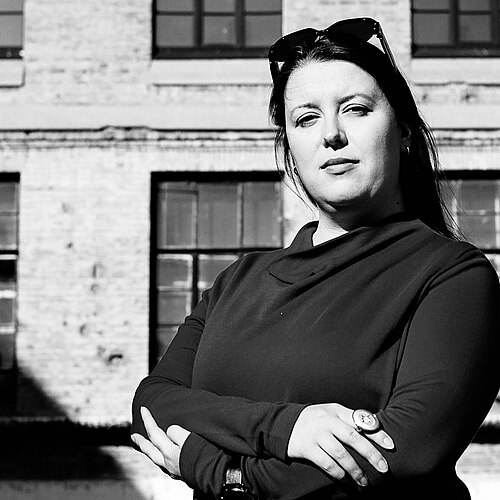
Difficult Heritage: Can We “Cut Off” History? A Conversation with Kateryna Kublytska
We speak with Kateryna Yevheniivna Kublytska – a Ukrainian architect and restoration specialist.
At the center of the conversation is the building of the Kharkiv Regional State Administration and a question that is being raised more and more often today: should it be preserved if it is associated with a traumatic past?
The expert’s position fundamentally differs from common assumptions: the building is not “lost”; it has retained a significant part of its structure and can be re-created.
Yet the key issue here is not even technical.
The KhОDA building is not just an object. It is a fragment of history that cannot be edited according to the principle of “like / dislike.” The postwar re-creation effectively produced a new building – a “child of the 1950s” – which has itself become an architectural monument.
Kateryna Kublytska emphasizes: an architectural monument is not only about aesthetics. It is evidence of the development of society, technologies, and the experience of previous generations.
Moreover, an attempt to reject “difficult” heritage may trigger a dangerous logic: first – the architecture of the 1950s, then – modernism (constructivism), then – imperial periods… and eventually, the complete erasure of historical memory.
In this perspective, trauma does not disappear – it only changes its form.
Another dimension is particularly important. This architecture is local – created here, using Ukrainian materials, by Ukrainian craftsmen. Even within the framework of socialist realism, it contains national codes that often remain unnoticed.
Thus, the question of re-creation is not only about the physical restoration of a building. It is about the capacity of society to work through its own memory.
And perhaps the central thesis of this conversation can be formulated as follows: history cannot be “cut off” without losing a part of ourselves.

